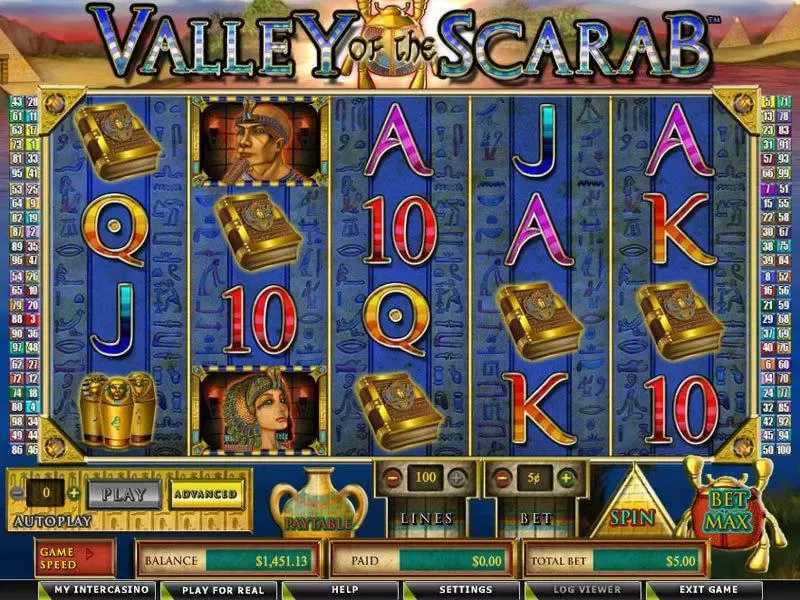
🏢 Provider: Amaya
📅 Released: 01.12.2012
🎯 RTP: 94,75%
⚡ Volatility: Unknown
🧩 Paylines: 100
How to Play Valley of the Scarab Slot for Real Money Online

1. RTP (Return to Player): 94.75%
The RTP of 94.75% indicates that, on average, a player can expect to receive back a strong 94.75 coins for every 100 coins wagered. This translates to a house edge of 5.25%, which is slightly above average for online slots, suggesting the potential for moderate returns, but at a lower margin than higher RTP games.
2. Paylines: 100
With 100 paylines, Valley of the Scarab offers a decent number of ways to win. This structure typically results in a balanced mix of winning combinations, allowing for both frequent smaller wins and the potential for bigger payouts. A player can expect to hit winning combinations relatively often, although the amount may vary depending on the specific symbols that land.
3. Max Bet Scenario:
By placing the maximum bet of $1,000 and hitting the top potential win of $1,000,000, a player can achieve large-scale wins:
Maximum win: $1,000,000 which indicates a token multiplier of up to x1,000 the bet amount, quite significant in the realm of online slots. Nevertheless, it’s essential to recognize such massive payouts are typically rare and contingent on ideal conditions.
4. Minimum Bet Scenario:
At the other end, if a player opts for the minimum bet of $0.01, the maximum theoretical win would mirror the top payout as follows:
Based on this scenario, the maximum win remains $1,000,000, making it theoretically achievable regardless of the betting amount.
Simple Expected Return Calculation:
Let's consider a scenario where a player spins 1,000 times at the minimum wager of $0.01 (total wager: $10):
With an RTP of 94.75%, the expected return would be calculated as follows:
This means the expected loss would be:
Expected loss = $10 - $9.475 = $0.525
This is merely an average and reflects the nature of luck-based games; actual results can vary greatly with the unpredictable nature of slot games.
Risk Evaluation:
The volatility is classified as "Unknown," which adds an element of uncertainty in terms of risk. High volatility usually suggests larger but less frequent wins, while low volatility indicates smaller but more frequent payouts. Consequently, the unknown risk could mean the potential for either thrilling large wins or prolonged dry spells.
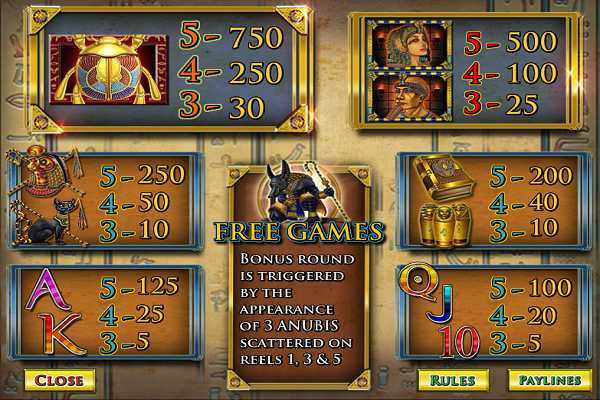
Valley of the Scarab Slot Machine – Screenshots