🏢 Provider: Light and Wonder
📅 Released: 24.01.2018
🎯 RTP: 96%
⚡ Volatility: High
🧩 Paylines: 10
How to Play Hula Hula Nights Slot for Real Money Online

1. RTP (Return to Player): 96%
The Return to Player (RTP) for Hula Hula Nights is 96%. This suggests that, on average, players can expect to return 96 coins for every 100 coins wagered. The remaining 4% represents the house edge, which is fairly standard in the gaming industry. This RTP indicates a balanced offering, as it is neither exceptionally high nor low.
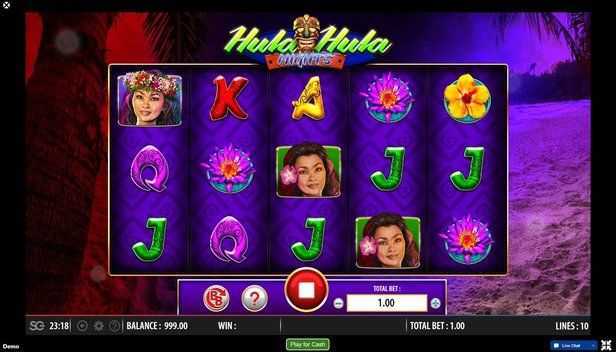
2. Grid and Paylines: 5-3 Grid with 10 Paylines
The game utilizes a 5 reels by 3 rows grid with 10 fixed paylines. This structure tends to offer varied winning combinations while keeping the gameplay straightforward. However, the limited number of paylines (just 10) suggests that wins may be less frequent compared to slots with a higher number of ways to win.
3. Volatility: High
With high volatility, Hula Hula Nights is likely to produce larger payouts, but these are less frequent. Players can expect substantial swings in their bankrolls over extended play sessions. This means winning spins can be significant, but players are also at risk of lengthy periods without substantial returns.
4. Maximum Bet Scenario
A player can stake a maximum of $500 per spin. Assuming a typical return consistent with RTP, let’s calculate the expected outcome:
Assuming the player bets $500, the expected return, using the RTP of 96%, would be:
Thus, from a $500 wager, the expected return would be $480, leading to an estimated loss of $20.
5. Minimum Bet Scenario
Conversely, the minimum stake is $0.10. Using the RTP for this bet level, the calculations would be as follows:
On a $0.10 bet:
This indicates that the player can expect to receive approximately $0.096 back for each $0.10 spin, resulting in an expected loss of about $0.004 per spin or 4 cents.
6. Expected Return Calculation
Consider a player spins 1,000 times at $1 per spin (total wager: $1,000). With the 96% RTP:
This means the player should expect to receive approximately $960 back after 1,000 spins, implying a $40 loss on average. However, this is a theoretical outcome, and in practice, the results can vary significantly due to the inherent variance of the slot.
Hula Hula Nights Slot Machine – Screenshots