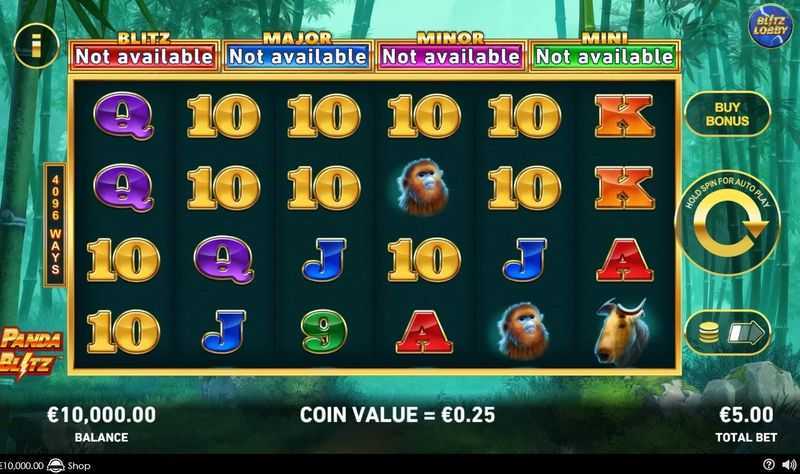
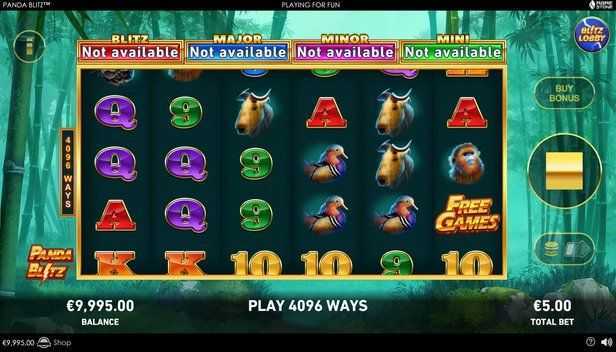
🏢 Provider: Rarestone Gaming
📅 Released: 26.09.2023
🎯 RTP: 90%
⚡ Volatility: Unknown
🧩 Paylines: 4096
How to Play Panda Blitz Slot for Real Money Online

1. RTP (Return to Player): 90%
The RTP of 90% suggests that on average, players can expect to receive back 90 coins for every 100 wagered. The remaining 10 coins represent the house edge. This RTP is considered relatively low in the gaming industry, implying a higher long-term risk and an expectation of greater losses for players compared to games with higher RTPs.
2. Paylines: 4096
Having 4096 paylines indicates a "ways to win" structure rather than traditional fixed paylines. This high number of winning combinations generally leads to more frequent, albeit smaller, wins. Players can anticipate action more often, providing the potential for steady gameplay if they are on a winning streak.
3. Max Bet Scenario:
If a player places the maximum bet of 500 and hits a substantial win (assuming the slot allows for such wins, despite "max_win": 0 likely indicating a high variance), the potential payout will be calculated under theoretical circumstances.
For example, if we consider a hypothetical high multiplier of x500 (note this is speculative due to no maximum win given):
Maximum win: 250,000. Given the note of "max_win: 0", it remains uncertain how realistic this scenario is, as there are no defined win limits.
4. Minimum Bet: 0.2
With the minimum bet set at 0.2, the maximum theoretical win becomes similarly speculative. Assuming the same hypothetical multiplier for consistency:
Thus, the theoretical max win at a minimum bet would be 100. This lower stake is beneficial for cautious players or those testing strategies, ensuring that bankroll management is less stretched.
Simple Expected Return Calculation:
If a player spins 1,000 times with a 1-coin bet (total wagered amount: 1,000 coins), the expected return based on the RTP of 90% would be:
Expected loss = 100 coins. This indicates a greater chance of loss compared to games with higher RTP rates, reinforcing the game’s potential risk factor.
Panda Blitz Slot Machine – Screenshots